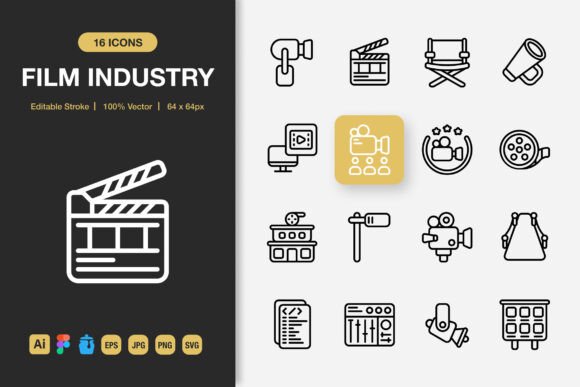
Film Industry Outline Icons: A Practical Asset for Modern Creators
Visual communication is a universal language, and in the fast-paced digital landscape, the right icon set can be the difference between a project that feels cohesive and one that feels disjointed. When you’re working on a design that touches on film, media, or storytelling, specialized resources like a set of Film Industry Outline Icons become incredibly valuable. This isn’t just about adding a cute camera symbol; it’s about integrating a consistent, professional visual vocabulary that immediately conveys your theme.
What makes a dedicated icon collection so compelling? For anyone creating content—from a blogger reviewing classic cinema to a marketing agency launching a campaign for a streaming service—these icons provide instant visual context. They allow you to communicate complex ideas like "directing," "cinematography," or "film editing" with simple, elegant glyphs. This saves time, enhances user understanding, and elevates the overall aesthetic. A high-quality set, like one described as featuring editable strokes and multiple file formats, is designed to integrate seamlessly, removing a significant technical hurdle from your workflow.
Common Pitfalls When Selecting and Using Icon Sets
Many creators, eager to speed up their process, make rushed decisions when sourcing graphical assets. This often leads to frustration down the line, undermining the very efficiency they sought. Let’s look at some typical missteps specifically related to utilizing thematic icon packs.
Overlooking File Format and Editability
A fundamental mistake is downloading an icon set based solely on its visual style without checking the technical specifications. You might find a beautiful pack of Film Industry Outline Icons, but if they are only provided as static PNG files with a fixed color and size, your flexibility vanishes. Imagine needing to adjust the stroke weight to match your brand’s typography or change the color for a dark-mode interface. Without source files like Adobe Illustrator vectors or SVG files, you’re stuck. This limitation can force you into a painful redesign or lead to inconsistent visuals across different platforms (e.g., your website icons look thick, while your app icons look thin).
Better Approach: Always prioritize sets that include scalable, editable source files. The mention of features like "Editable Stroke" and "SVG File" is a direct signal of this flexibility. Before committing, ensure the package includes the formats you actually use in your daily tools—whether it’s Figma, Illustrator, or even a library manager like Iconjar. This allows you to adapt the icons to your project’s exact needs, not the other way around.
Ignoring Consistency and Scope
Another frequent oversight is assuming an icon set will cover every possible need. You might purchase a film-themed pack expecting an icon for a "film festival ticket booth," only to find it’s not included. This leads to the patchwork problem: mixing icons from different sets with varying styles, which immediately breaks visual harmony. A user’s experience on your website or app can become confusing when icons don’t share the same line weight, corner radius, or level of detail.
Better Approach: Review the full icon library before use. A quality set should offer a comprehensive range of symbols relevant to the film industry—from basic equipment (clapperboard, camera) to abstract concepts (storyboard, spotlight). Assess if the included icons (often listed as 100 customizable items) cover your core use cases. For niche needs, consider using the editable files to creatively modify existing icons, perhaps combining elements, rather than introducing an alien style from another pack.
Misapplying Icons in Context
Even with perfect technical assets, poor application can dilute their impact. A common misunderstanding is using these outline icons in overly busy compositions. Their minimalist design is a strength, meant to communicate clearly without distraction. Placing them on a background with heavy texture or clashing colors can render them illegible. Similarly, using them at an incorrectly small size on a poster or an incorrectly large size on a mobile app button can undermine their purpose.
Better Approach: Respect the icon’s design philosophy. These outline icons are tools for clarity. Use them in layouts with adequate contrast and breathing space. For instance, on a social media flyer announcing a film competition, let the icon for "award" stand out with ample padding, not crammed between blocks of text. Test their readability at various sizes across different outputs—the PNG transparency files are great for quick mockups in diverse contexts like banners or printed flyers.
Key Considerations Before Integrating Film Industry Icons
To avoid these pitfalls and ensure a smooth, effective project, take a moment for a practical pre-flight check. This isn’t about doubt; it’s about preparation.
First, audit your project’s actual needs. Map out where icons will function: navigation menus, call-to-action buttons, illustrative decorations, or infographic elements. This tells you how many icons you need and what styles (perhaps outline vs. filled) might work best for each function.
Second, verify compatibility with your workflow. The promise of "Easy Drag and Drop Files" and specific source files (Figma, Illustrator, EPS) is excellent, but confirm they match your software versions and team’s skills. A Figma file is invaluable for UI/UX designers, while an EPS version 10 might be crucial for a print shop handling your poster.
Third, plan for customization. Even with 100 icons, you might need to tweak. Open the source file early and test a simple edit—like changing the color of one icon. This confirms the editability isn’t locked or overly complex. The included Readme.txt file should be your first stop for any technical instructions on how to best use the files.
Turning Assets into Effective Communication
The ultimate goal is to enhance your project’s message, not just decorate it. Well-chosen Film Industry Outline Icons act as intuitive signposts. For an educator creating a film history course module, icons for "silent film" or "color grading" can break down complex topics visually. For a freelancer designing a client’s film production company website, icons for "scriptwriting" and "sound design" can quickly outline services offered.
Remember, the value lies in the system. By using a complete, high-quality, and adaptable set, you ensure that from your website’s header to your mobile app’s settings screen, to the PDF brochure you email, the visual language remains coherent. This cohesion builds brand recognition, improves user navigation, and communicates professionalism. It turns a collection of individual icons into a powerful, unified tool for storytelling—fitting, given the film industry theme.
In essence, selecting a resource like this is about investing in clarity and efficiency. By avoiding the common traps of inflexible files, inconsistent scope, and poor context application, you unlock the full potential of these minimalist designs. They become not just images you place, but integral components of your design language, ready to adapt and shine across websites, apps, books, and all the many mediums where you tell your story.