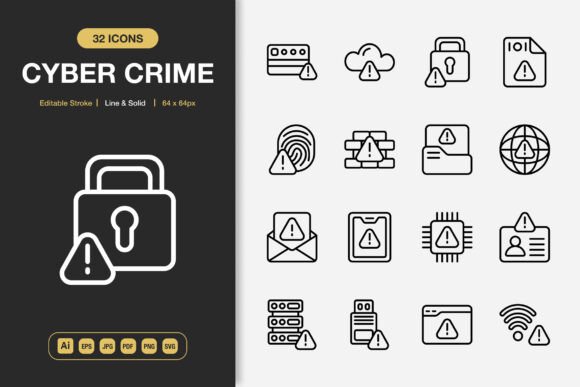
The Digital Security Toolkit: How Cyber Crime Icons Enhance Modern Communication
In an era where digital security is a daily conversation, visual language becomes paramount. Communicating concepts of cybersecurity, data protection, and online threats requires clarity and immediate recognition. This is where a dedicated set of Cyber Crime Icons transcends mere graphics to become a functional toolkit. For professionals, creators, and educators, these icons offer a precise vocabulary to illustrate complex digital risks in an accessible way. Their relevance stems not just from the subject matter but from their design philosophy: minimalism, versatility, and high-quality execution that meets the rigorous demands of contemporary projects.
The Evolution of Visual Communication in Tech Security
The way we discuss technology has shifted dramatically. Once confined to IT departments, topics like phishing, malware, encryption, and identity theft are now mainstream. This shift necessitates a parallel evolution in our visual aids. Generic warning signs or abstract symbols no longer suffice. Audiences expect specific, intuitive imagery that matches the sophistication of their understanding. A set of high-quality icons dedicated to cyber crime fills this gap. It provides a standardized visual lexicon that can unify presentations, public awareness campaigns, internal training materials, and consumer-facing applications.
This evolution is driven by changing habits. We consume information rapidly across websites, mobile apps, and social media feeds. In these environments, a well-designed icon can convey a message faster and more effectively than paragraphs of text. For a blogger explaining ransomware, a marketer promoting a security service, or a business owner creating a safety protocol flyer, the right icon serves as an anchor for the audience’s attention and comprehension.
Minimalism as a Functional Necessity
The assertion that minimalist icon design can change your next projects is not an empty promise; it’s a practical observation. Minimalism here is not just an aesthetic choice but a functional one. Clean lines, uncluttered shapes, and clear symbolism ensure that icons remain legible across the vast spectrum of modern use cases—from a tiny favicon on a website to a large poster in a corporate hallway. The Cyber Crime Icons set, with its line and solid style options, offers this essential clarity.
This design approach caters directly to modern workflows. Whether you’re prototyping a mobile app interface in Figma, laying out an infographic in Adobe Illustrator, or preparing a slide deck, icons that are easily recognizable at various sizes streamline the design process. They integrate seamlessly without overpowering other content. The availability of icons in multiple resolutions—from 32px for UI elements to 512px for print—means designers no longer need to sacrifice quality or spend time manually scaling assets. This ready-to-use scalability is a direct response to the time-sensitive nature of current creative and professional work.
Practical Implications for Diverse Users
The value of this icon set unfolds differently depending on the user’s role. For a freelance web developer, the included SVG files mean they can implement icons directly into code, ensuring sharp rendering on any screen and allowing for dynamic color changes via CSS. For an entrepreneur crafting investor pitches, the PDF and JPG files provide quick, high-quality inserts into business documents and presentations. For a print shop producing banners and flyers for a cybersecurity conference, the high-resolution PNG files with transparency guarantee professional-grade output.
The feature of an editable stroke in the source Adobe Illustrator file is particularly significant. It empowers advanced users to adapt the icons to specific brand guidelines or project themes without losing the core design integrity. This level of customization moves the product from a static asset pack to a dynamic design foundation. Meanwhile, the easy drag-and-drop nature of the files respects the needs of less technical users, such as educators or hobbyists creating social media content, who require efficiency and simplicity.
The Comprehensive File Suite: A Foundation for Professional Use
A truly suitable icon set for any project must anticipate the multitude of software environments and end uses in today’s market. The included file formats speak directly to this professional requirement. The EPS Version 10 file ensures compatibility with a wide range of vector editing and publishing software, safeguarding the investment for future use. The provision of a source Adobe Illustrator file is a gold standard, offering complete control over every element for those who need it.
This comprehensive approach solves a common pain point: asset fragmentation. Instead of searching for or converting disparate files, a user receives a cohesive package. The Readme.txt file, often overlooked, adds a layer of user-friendliness, potentially guiding setup or explaining format specifics, which enhances the overall experience and reduces friction. This attention to detail reflects an understanding that professional workflows depend not only on the quality of the assets but on the smoothness of their integration.
Integrating Icons into Current Trends and Business Needs
Current trends in digital content lean heavily towards visual storytelling and data simplification. Infographics are more popular than ever for breaking down complex subjects like cyber crime statistics. A curated set of icons provides the building blocks for such graphics. Similarly, the rise of online learning and micro-training modules demands engaging visual aids. These icons can animate tutorials, highlight key points in eBooks, or serve as identifiers in course materials.
For businesses, communicating security policies internally or promoting security services externally is a critical need. Uniform, high-quality icons help establish authority and trust. They make guidelines more memorable and marketing materials more cohesive. When a brand consistently uses clear, professional icons to discuss security, it reinforces its own commitment to the topic. This alignment of visual tools with business messaging is a subtle yet powerful aspect of modern branding and communication.
Why Versatility Matters in a Multi-Platform World
The declaration that these icons are perfect for websites, mobile apps, books, social media, infographics, flyers, print, banners, posters, and many more is a testament to a core design principle: platform agnosticism. In a world where a single campaign might span an Instagram post, a newsletter banner, and a conference poster, using consistent visual elements across all touchpoints reinforces message unity. The Cyber Crime Icons set is engineered for this multi-platform reality.
The 100 customizable icons offer a broad enough range to cover most thematic needs without being overwhelming. This balance is crucial. It allows a user to tackle a project without feeling limited, yet also avoids the paralysis that can come from navigating thousands of irrelevant options. Each icon, from representations of firewalls to data breaches, is designed to be a clear, standalone symbol, making it effective whether used singly in an app interface or grouped in a complex poster layout.
Ultimately, the power of a specialized icon set lies in its ability to elevate communication. By providing a precise, scalable, and adaptable visual language for the crucial topic of cyber crime, this collection moves beyond decoration to become a practical instrument. It aligns with the pace, precision, and platform diversity of today’s creative and professional demands, offering a resource that is as useful for a quick social media graphic as it is for a detailed technical manual. In doing so, it exemplifies how thoughtful design resources can genuinely change the scope and quality of our next projects.