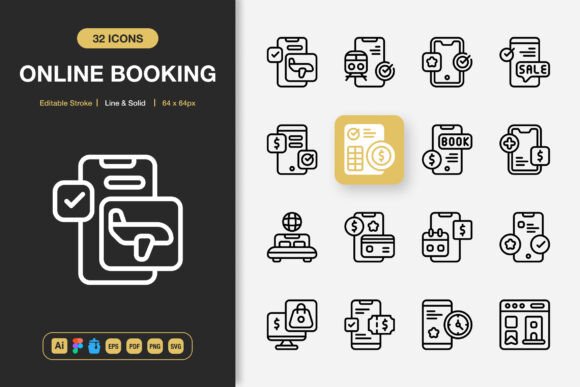
Streamlining Digital Communication with Professional Online Booking Icons
In a digital environment saturated with information, the clarity and efficiency of communication are paramount. For entrepreneurs, creators, and businesses managing services, appointments, or reservations, visual cues can dramatically reduce cognitive load for users. A set of high-quality Online Booking Icons serves as a strategic toolkit, enabling you to replace lengthy textual explanations with intuitive, universally recognizable symbols. This isn't merely about decoration; it's about constructing a more effective interface that guides users, reinforces your brand's professionalism, and accelerates transaction completion.
The Strategic Advantage of a Comprehensive Icon Set
Investing in a well-designed icon library is a decision rooted in operational efficiency and user experience design. When your project—whether a website, mobile app, or printed material—requires users to book, schedule, or reserve, consistent visual language becomes a silent ambassador for your process. The specific value of a dedicated Online Booking Icons collection lies in its completeness and adaptability. Instead of piecing together disparate symbols from various sources, you gain a unified visual system. This coherence supports your goals of building a trustworthy digital presence where users feel confident and guided through every step, from selecting a date to confirming a payment.
Aligning Icon Design with Functional Goals
Thoughtful use of these icons begins with intentional planning. Before integrating any symbol, consider its function within the user's journey. Is an icon meant to indicate a calendar view, a time slot selection, a confirmation step, or a payment method? Each Online Booking Icons element should map directly to a user action or a key piece of information. This strategic alignment ensures the icons serve as functional aids, not just aesthetic elements. For instance, a clear, minimalist icon for "guest profile" on a hotel booking site instantly communicates where users can manage their details, potentially reducing support queries and streamlining the process.
Key Features for Practical Implementation
The technical specifications of a professional icon set directly impact its strategic utility. The inclusion of both line and solid styles offers flexibility for different contexts—a light line style for a minimalist app interface, or a solid fill for a prominent call-to-action button. Editable stroke and fully customizable vectors mean you can adapt the icons to match your exact brand colors, thickness, and style, ensuring seamless integration with your existing design ecosystem without compromising visual identity.
From a project management perspective, the bundled file formats are a critical consideration for long-term efficiency. Having source files in Adobe Illustrator and Figma allows designers to make deep customizations. The Iconjar file facilitates organized library management, while the EPS, PDF, SVG, and PNG files at multiple resolutions (from 32px to 512px) guarantee readiness for any output: web, mobile, print, or social media. This eliminates the common bottleneck of asset preparation, saving valuable time and allowing teams to focus on higher-level UX and business logic.
Expanding Use Beyond Digital Screens
While the term "online booking" suggests digital use, the application of these icons extends far beyond websites and apps. Their minimalist design makes them perfect for a holistic communication strategy. Consider using them in printed flyers or posters to promote an event booking system, in infographics explaining a service workflow, or in physical banners at a location that directs customers to an online reservation portal. This cross-media consistency strengthens brand recognition and ensures users encounter the same visual cues regardless of how they interact with your service.
A Guide to Intentional Integration and Planning
To leverage Online Booking Icons effectively, approach their integration as a component of your overall user interface strategy. Start by auditing your current booking or scheduling touchpoints. Identify areas where text is dense, actions are ambiguous, or the process feels cluttered. These are prime candidates for icon implementation. Plan a small, controlled rollout—perhaps starting with the core actions like "Book Now," "Select Date," and "Confirm"—to test user comprehension and engagement before deploying the full set.
It is also vital to consider cultural and contextual symbolism. While many booking-related icons (like a calendar or clock) are widely understood, ensure your target audience interprets them correctly. User testing or feedback loops on new icon implementations can provide this insight. The goal is to use icons intentionally to simplify, not to introduce new ambiguity.
Potential Risks of Unconsidered Icon Usage
Without clear goals, the use of any icon set, including Online Booking Icons, can backfire. Overloading an interface with too many symbols can create visual noise and confusion. Inconsistent application—using different styles or meanings for the same action across different pages—can erode user trust and increase learning friction. Furthermore, relying on icons alone without supporting text labels for critical actions can be a risk, particularly for users with varying levels of digital literacy or visual impairments. A strategic approach always balances iconography with clear textual fallbacks and logical information hierarchy.
Long-Term Value for Projects and Brands
The decision to adopt a high-quality, customizable icon set is an investment in your project's future scalability. As your service expands or your branding evolves, having a central library of editable Online Booking Icons ensures you can adapt visuals without restarting from scratch. This maintains long-term brand consistency, which is a key driver of customer loyalty and perceived reliability. For freelancers and small business owners, it also represents a professional asset that elevates the quality of client work, potentially leading to better outcomes and referrals.
Ultimately, these icons are tools for clearer communication. Their value is unlocked not by simply having them, but by weaving them thoughtfully into the fabric of your user experience. When selected and applied with purpose, Online Booking Icons can transform a functional process into an intuitive, efficient, and professionally polished journey for your customers, contributing directly to better completion rates and a stronger overall brand presence.